Recently, the 2026 Chinese Government Scholarship International Summer School“International Innovation and Entrepreneurship”Summer Training Camp, organized by the Business School of Hunan University, successfully concluded. Ten teachers and students from Vietnam National University, Hanoi, joined 30 current international students from seven countries, including Indonesia and Morocco, to enter the classroom and learn together.
Case-based Teaching
A Case Study Beyond Textbooks: Re-recognizing“Made in China”in Real Business Contexts
How can a Chinese enterprise going global navigate the global market steadily and sustainably? This question stems from the 17th “National Top 100 Excellent Management Cases” entry by Ms.Xu Yan from theBusiness School’s Department of Finance,titled “When Will the Dust Settle, When Will Glory Return: ZXMOTO’s Globalization Choices from Track to Market”, which also serves as the core teaching case for this training camp.

Case-based Teaching
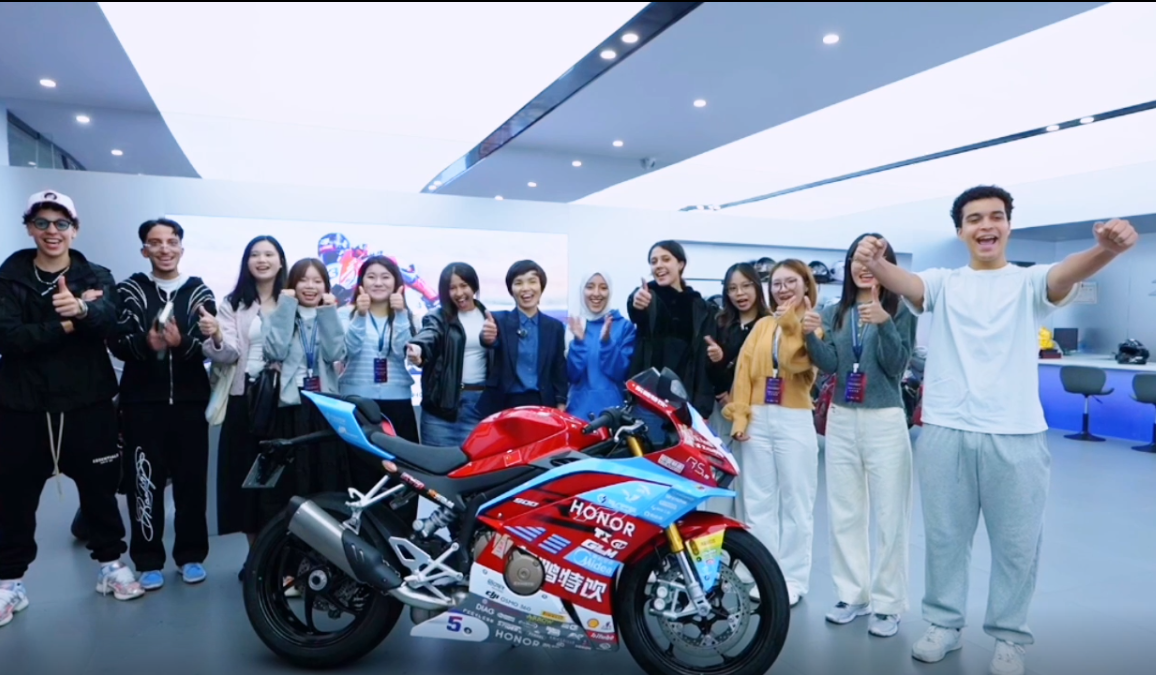
“Case teaching is not about presenting a ready-made‘formula for success,’but rather about allowing students to enter real business scenarios and experience the complete process of management decision-making.”Ms.Xu Yan broke away from one-way lecturing, moving the first class directly to the storefront of the local emerging brand “Zhangxue Motorcycle (ZXMOTO).” Five study groups conducted field visits to inspect the company’s operations, engaged in face-to-face communication with store managers and riders, and gained a close-up understanding of the authentic processes of brand building and market expansion.
Combining research materials, each group carried out multiple rounds of discussion and proposal refinement, continuously deepening their understanding of the enterprise’s current status and overseas expansion strategies. In Ms.Xu Yan’s high-quality case demonstration class, students generated 5 proposals from diverse perspectives by integrating their respective national contexts: Vietnamese students advocated establishing the brand before focusing on sales volume; Moroccan students moved beyond low-price thinking, suggesting a step-by-step approach to opening up regional markets; Indonesian students suggested leveraging racing tracks and rider communities to penetrate the market, while others proposed broadening channels by researching European and Australian markets.

Case-based Teaching
Behind the five solid group research reports lies the broadening of international students’ understanding of the globalization of Chinese enterprises. For the first time, they witnessed up close how the transformation of“Made in China”today is giving rise to a large number of emerging entrepreneurial forces that possess both a global vision and technological innovation.
A Three-Dimensional In-Depth Study Tour:From Cultural Perception to Diversified Industrial Practice
Understanding the globalization process of Chinese enterprises cannot be separated from understanding their socio-cultural context and industrial ecology. Centered on core cases, theBusinessSchoolorganically integrates cultural experiences, thematic classes, and corporate visits. It is also equipped with a Vietnamese coordination team to handle itinerary coordination, living logistics, and course tutoring.
Using culture as a bridge to expand the horizons of going global.Participants visited Yuelu Academy, Orange Isle, and city business districts, experiencing cultural activities such as calligraphy. The Mango Supermedia team was invited to share localization experiences regarding“Mango’s Global Expansion”and present internship opportunities, allowing participants to further appreciate the profound heritage of Hunan (Xiang) culture and the charm of the Hunan media powerhouse.

Calligraphy Experience Class
Building a cognitive framework based on the classroom.The training camp organized 4 lectures focusing on the“Dual Circulation”theory, China-Vietnam supply chain collaboration, AI applications, and cross-border trade. In the course“Practical Full-Process Operations and Customs Simulation of China-Vietnam Cross-Border Trade under the RCEP Framework,”students selected trade models, studied pricing mechanisms, and mastered cross-border trade skills through hands-on simulations.

Student Sharing Session
Taking industry as the path to deepen practical understanding.Trainees visited Yite Medical to learn about the medical equipment R&D process; they also visited Renhe Environment to observe the resource utilization of kitchen waste and the smart sanitation dispatch process, intuitively experiencing how green technology empowers urban public services in China.


Enterprise Visits
This activity marks the second consecutive year that theBusiness Schoolhas co-organized a summer training camp with Vietnamese universities. From a single lecture to a case study, and further to a study-tour chain connecting the classroom with industry, this model is being refined into a replicable and scalable experience. In the future, theBusiness Schoolwill continue to deepen its internationalized education, bringing more real-world stories of local enterprises into international classrooms to cultivate more business talents with a global vision.