By Yang Chao and Wang Yujia, Correspondents, Hunan Daily
Twenty years of dedication—enough time for saplings to grow into a towering forest, and enough for a university-enterprise partnership of mutual empowerment to take deep root in the fertile soil of China's manufacturing sector, advancing steadily and purposefully every step of the way.
Since the two sides initiated their cooperation in 2006 and launched the first MBA executive program in 2007, the School and Zoomlion have forged a 20-year partnership in industry-education integration. Over this period, the School has delivered dozens of customized executive training programs, reaching more than 1,800 attendances, with 80% of program participants receiving promotions. Anchored in the imperatives of manufacturing digital transformation, global expansion, and industrial chain synergy, the partnership has precisely aligned university intellectual resources with cutting-edge industry needs, building a multi-tiered talent cultivation system and a highland for talent development that serves national strategic priorities—charting a distinctive path of deep integration and resonance between industry and academia.
Starting Together: Addressing Enterprise Needs, Exploring Customized Cultivation Pathways
In 2006, as the construction machinery industry entered a period of expansion, Zoomlion continued to broaden its business footprint. As the company scaled up, challenges emerged: most mid- and senior-level managers had risen from frontline technical positions. They possessed rich practical experience but lacked systematic management training, and there was a particularly acute shortage of professionals proficient in both production technology and business management.
How could the company close its talent gaps? How could it build a systematic learning platform tailored to its own business? With these development challenges in mind, Zoomlion approached the School, which had well-established executive education resources, and the two sides reached a consensus on long-term strategic cooperation.
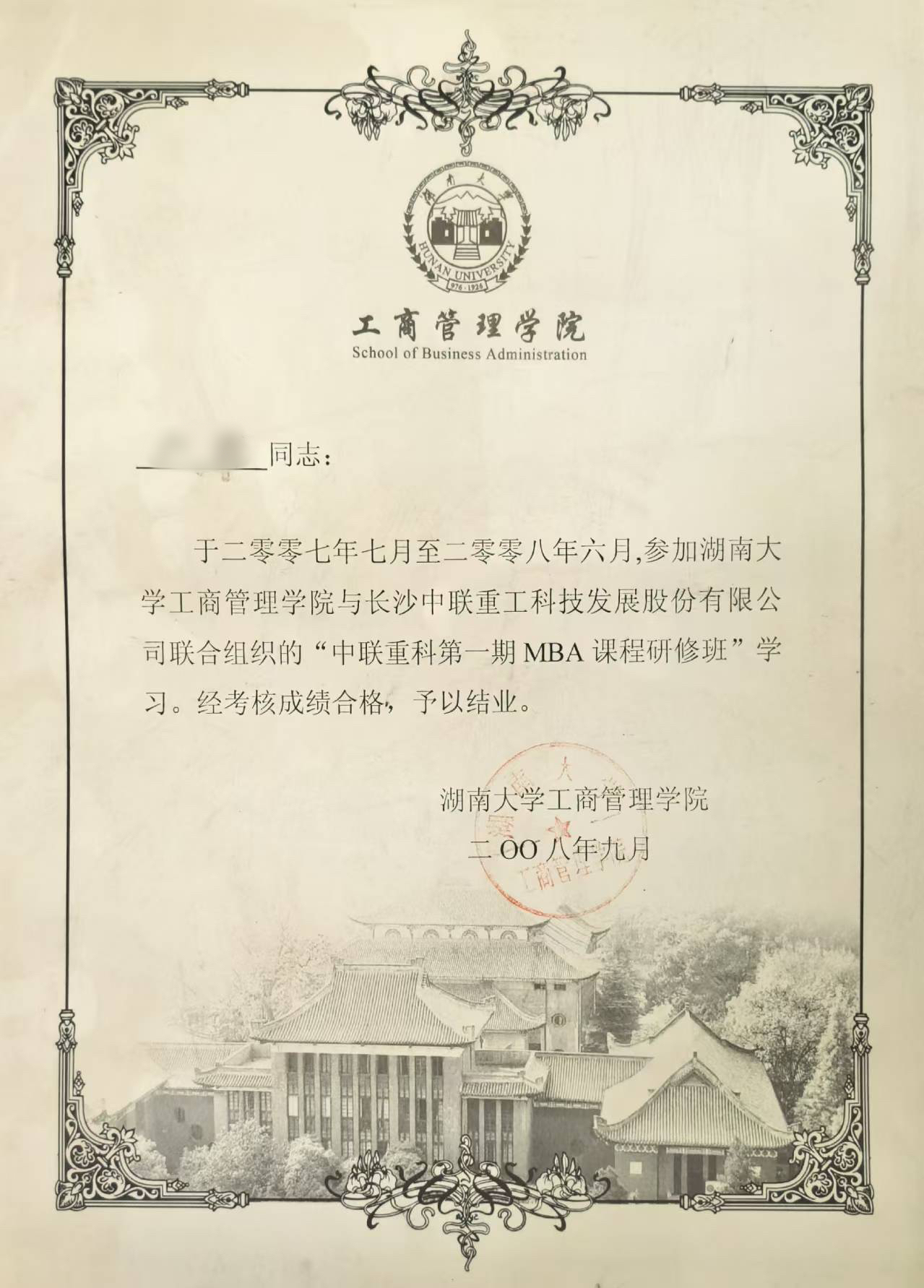
(Certificate of completion for the first cohort of the Zoomlion MBA executive program)
In 2007, the first Zoomlion MBA executive program was launched. At that time, there were virtually no ready-made models for university-enterprise customized training. How could course content truly align with the company's real needs and solve its pain points? To address this challenge, the School's teaching and research team proactively went to the front lines, conducting field visits to major production bases and business units to analyze and identify genuine management bottlenecks in workshop manufacturing, R&D innovation, and overseas market expansion. Beginning in 2011, through continuous iteration of the cultivation system and by incorporating needs lists compiled across Zoomlion's business lines, the two sides established a strategic cultivation approach: "the enterprise poses the questions, the university delivers the instruction, and results are delivered on the ground." The effectiveness of talent development gradually became apparent.

(Group photo of the 2011 trainees)
In 2016, the talent cultivation model underwent a transformative upgrade with the launch of the first Executive Development Program (EDP) class. The biggest change this time was that real enterprise cases were not only incorporated into teaching materials but also applied directly to enterprise production. Participants formed groups to conduct in-depth research on two core topics—marketing layout and aftermarket operations—and ultimately produced a complete optimization plan. This research outcome, born in the classroom, was submitted to the company's board of directors, providing important reference for subsequent business optimization and strategic adjustments, and achieving effective translation of classroom results into enterprise productivity. From classroom to decision-making level, from proposal to tangible results, the value of this customized cultivation model was powerfully validated.
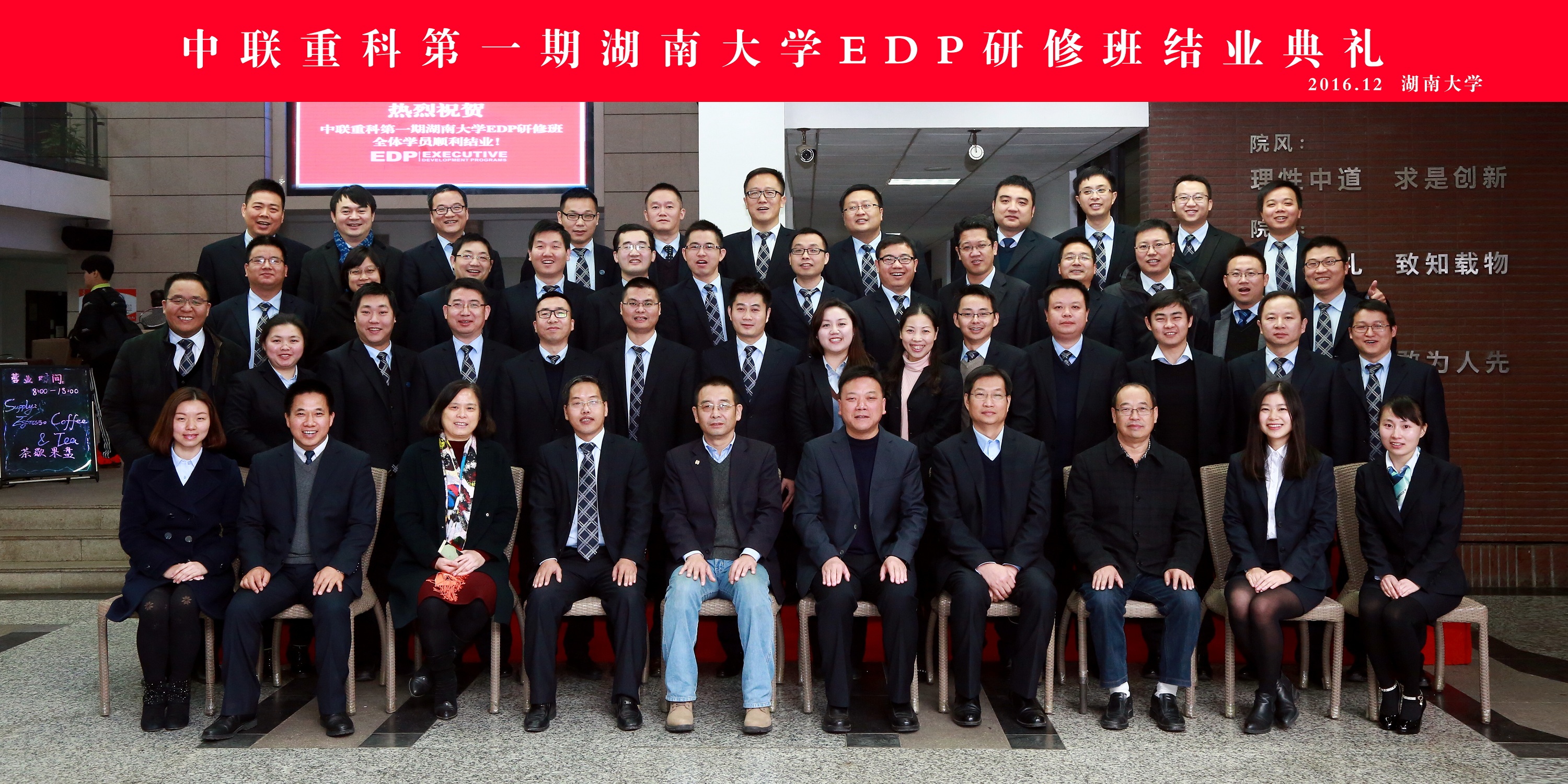
(Group photo of the 2016 trainees)
Deepening and Enhancing Quality: From "Pilot" to "Regular Practice," Building a Comprehensive Talent Cultivation Framework
After the first executive program proved viable in 2007, cooperation between the two sides advanced steadily and continued to evolve. A tiered and categorized curriculum system gradually took shape, and a stable, long-term talent cultivation mechanism was put into solid operation. Both sides recognized that this path was not only viable but worth pursuing deeply and extensively. Subsequently, course coverage expanded from the initial mid- and senior-level management backbone to global overseas teams and upstream and downstream partners, while course content evolved from general management to more targeted areas such as industrial chain synergy, digital-intelligence transformation, and international empowerment. A comprehensive talent cultivation framework covering diverse groups and multiple dimensions gradually took shape.
In 2019, Zoomlion came to a deep insight that the competitiveness of modern industrial chain depends not on how strong any one company is, but on the comprehensive supporting capability of the entire ecosystem. Accordingly, the "Sustaining Excellence" training program series was launched successively for national suppliers, distributors, and other partners: the first cohort began in 2019, an advanced second cohort followed in 2020, and the curriculum was upgraded again in 2023, serving hundreds of leaders and core personnel from industrial chain enterprises.

(Classroom learning and exchange)
In terms of curriculum design, the series program established a full-chain empowerment system of "academic think tank + benchmark study tours + industrial chain co-construction." This included systematic theoretical lectures by university professors, field study tours to benchmark enterprises, and practical experience sharing by frontline senior executives from Zoomlion. In the classroom, numerous suppliers, distributors, and other upstream and downstream partners in the industrial chain participated together, exchanging ideas and connecting development resources. Many enterprises used this opportunity to open new business horizons, achieving a leap from "going it alone" to "win-win cooperation."

(Letters from the "Sustaining Excellence" series training program)
As manufacturing advances toward digitalization and intelligentization, a big challenge is the shortage of versatile talent proficient in both technology and management. To address this, the School tailored multiple EE programs themed in both digitalization and intelligentization, breaking away from a purely theoretical teaching framework and closely following real-world challenges across the entire production, R&D, and manufacturing process. These programs adopted a cultivation model of "theoretical instruction + topic seminars + on-site implementation," bringing real production-line challenges into the classroom.
The most representative initiative is the "Lion Strategy Digital-Intelligence Camp". The 2021 Changde Digital-Intelligence Camp for Manufacturing System Managers and the 2023 second digital-intelligence camp were launched successively. Participants were key business personnel from Zoomlion's pumping, earthmoving, and high-altitude machinery business units. How should foundational data be governed? How should the BOM architecture be restructured? How should a smart factory be built? Answers to all of these could be found in the classroom.

(Digital-Intelligence executive program)
During the learning process, participating worked in groups on practical projects. One group completed a research project on enterprise digital transformation through reviewing systematically the company's IT infrastructure, planning the BOM management system upgrade, and deploying ten business platforms including PLM, MES, and WMS, as well as detailing implementation milestones and budget arrangements.
This plan, embodying collective wisdom, helped the company carry out multiple digital upgrade tasks in an orderly manner, gradually establishing 12 categories of smart dashboards for operations, manufacturing, and R&D, and fully connecting data channels across R&D, production, and logistics. As planned, once the complete system is operational, the automatic collection rate of production process data reaches over 85%, with steady growth in tower crane capacity. Meanwhile, comprehensive energy consumption—including water, electricity, and natural gas— is to decrease by 5%, and both inventory and logistics efficiency improve significantly. These figures demonstrate that the classroom is not "empty theory" but has been solidly translated into operational benefits.
As a leading domestic equipment manufacturing enterprise, Zoomlion continues to advance its internationalization strategy, with operations covering more than 180 countries and regions. After "going global," the company faces increasing difficulty in cross-regional management. Different countries have different market rules and cultural environments. Hence, how to lead management teams and how to promote localized business are real challenges that must be addressed.

(Specialized "Going Global" courses)
In 2024, the School tailored specialized "Going Global" courses and executive programs for Zoomlion, targeting overseas managers on active duty and focusing on practical content such as overseas compliance operations, local team management, and regional market operations. The entire international curriculum closely aligns with the actual overseas scenarios of the construction machinery industry, systematically enhancing the cross-cultural management capabilities of overseas managers.
In the earthmoving machinery "Excavator Leaders Camp" EE program launched the same year, participating trainees were managers and key business personnel from 13 global regions. The curriculum, aligned with corporate strategy, focused on deconstructing key challenges in overseas business expansion, cross-regional team collaboration, and overseas customer service. Participating trainees, drawing on the current market conditions in their respective regions, injected strong intellectual momentum into Zoomlion's in-depth advancement of its globalization strategy and high-quality brand "going global" through tailored business strategies.
Mutual Empowerment: Building a Win-Win University-Enterprise Education Ecosystem
The effectiveness of talent cultivation ultimately comes back to individual growth. Data shows that the overall promotion rate among program participating trainees reached 80%, with flagship classes exceeding 90%. Taking the first EDP class in 2016 as an example, three participants later grew into senior executives at Zoomlion; across the four classes between 2016 and 2020, more than 20 participating trainees assumed senior executive positions in business units. Behind these numbers are concrete growth stories and direct proof of the value of this university-enterprise joint cultivation model.

(Classroom training, 2026)
The relationship between university and enterprise is not a one-way assembly line of "the school teaches and the enterprise uses," but rather deep interaction and mutual engagement. Zoomlion's senior executives and industry experts also come onto campus, serving as competition judges and hosting industry sharing sessions, bringing real frontline cases and industry pain points into the classroom. This "two-way flow" of theory and practice keeps classroom teaching in step with the pace of industrial change.
In terms of course design, sand-table exercises, outdoor development activities, and real-world projects are interspersed throughout. Beyond the classroom, activities such as basketball games, book sharing sessions, public welfare initiatives, and the Gobi Desert Challenge are conducted with great enthusiasm. Participants draw closer through collaborative work, transitioning from "classmates" to "comrades-in-arms," creating a more vibrant learning atmosphere.

(Participants in the Gobi Desert Challenge)
University classrooms help enterprise personnel broaden their horizons and enhance their capabilities, while real frontline cases and practical resources from the enterprise continuously enrich teaching. In this way, both university and enterprise empower each other, jointly building an innovative ecosystem of industry-education integration that co-evolves and co-thrives.
As a leading enterprise in the equipment manufacturing field, Zoomlion is rooted in Hunan, radiates across the country, and operates globally—a vivid microcosm of China's advanced manufacturing development. The customized high-end talent cultivation model jointly developed by the School and Zoomlion is grounded in the realities of industrial development and serves the construction of a modern industrial system. It continuously cultivates high-level management talent suited to the development of advanced manufacturing, provides intellectual support for promoting the high-end, intelligent, and green development of manufacturing, and explores cutting-edge and practical industry-education integration pathways for developing new quality productive forces and promoting high-quality regional economic development.

(Trainees attending class on campus)
Looking ahead to the 15th Five-Year Plan (2026–2030), the School will remain grounded in national development strategies, adhering to the integrated advancement of education, science and technology, and talent. Keeping pace with industrial transformation and enterprise development needs, the School will continue to deepen industry-education integration with leading enterprises such as Zoomlion, continuously improving its high-level management talent cultivation system, contributing to Hunan's "Three Highlands and Four New Missions" Strategy and providing Hunan University's business wisdom and strength to advance Chinese modernization.