On March 29, the 2026 Symposium on Doctor of Professional Accounting (DPAcc) Talent Development was held at the School of Business, Hunan University. The symposium was guided by the National Accounting Professional Degree Education Steering Committee (hereinafter referred to as the "Steering Committee") and hosted by the School. Attendees included Zhi Xiaoqiang, Secretary-General of the Steering Committee and Vice President of Renmin University of China; Liao Jizhong, Deputy Party Secretary and Secretary of the Discipline Inspection Commission of Hunan University; relevant officials from the Guidance Center of the Steering Committee (Department of Accounting, Ministry of Finance); members of the Steering Committee; representatives from DPAcc program institutions; and representatives from the Secretariat of the Steering Committee. Yang Zhi, Dean of the School, presided over the opening ceremony, and Zhang Yuejun, Party Secretary of the School, presided over the closing ceremony.On March 29, the 2026 Symposium on Doctor of Professional Accounting (DPAcc) Talent Development was held at the School of Business, Hunan University. The symposium was guided by the National MPAcc Education Steering Committee (hereinafter referred to as the "Steering Committee") and hosted by the School. Attendees included Zhi Xiaoqiang, Secretary-General of the Steering Committee and Vice President of Renmin University of China; Liao Jizhong, Deputy Party Secretary and Secretary of the Discipline Inspection Commission of Hunan University; relevant officials from the Guidance Center of the Steering Committee (Department of Accounting, Ministry of Finance); members of the Steering Committee; representatives from DPAcc program institutions; and representatives from the Secretariat of the Steering Committee. Yang Zhi, Dean of the School, presided over the opening ceremony, and Zhang Yuejun, Party Secretary of the School, presided over the closing ceremony.
At the opening ceremony, Liao Jizhong delivered a welcome address on behalf of Hunan University. He noted that DPAcc education serves as a critical engine for cultivating high-level applied accounting professionals in China. As the accounting and finance industry accelerates its transformation toward digital intelligence and strategic upgrading, there is an urgent need to ground talent development in the needs of the times, in China's own practices, and in national strategies, while deepening the integration of industry and education as well as the integration of research and education. As one of the first batch of DPAcc program institutions nationwide, Hunan University has long been committed to cultivating high-end accounting talent, actively aligning with social needs and industry development, and nurturing high-level organizational leaders with profound professional accounting competence, a grounding in China's fine history and culture, and a global vision and strategic thinking—marking a new stage in the university's high-level accounting talent development system.
In his address, Secretary-General Zhi Xiaoqiang emphasized that DPAcc talent development must "fasten the first button correctly" (i.e., get off to the right start) from the outset—precisely defining educational positioning, deeply refining professional characteristics, proactively serving major national strategic needs, and striving to build the professional brand and social reputation of DPAcc.
Following the opening ceremony, participants engaged in in-depth discussions on topics including DPAcc talent cultivation model, curriculum design, quality evaluation, and practical skills to comprehensively review the current status of DPAcc programs across participating institutions.
At the closing ceremony, Secretary-General Zhi Xiaoqiang summarized the symposium. He pointed out that all program institutions should ground themselves in their own positioning, integrate DPAcc education into their overall institutional development strategies, and actively seek policy support. They should accelerate the development of distinctive approaches for professional degree cultivation, building on case-based teaching to explore deeper integration of industry, academia, research and application. Institutions should also proactively respond to shifting trends in student demographics, refine implementation details, and cultivate differentiated advantages. He stressed the importance of strengthening inter-institutional collaboration and platform development, focusing on brand image building, jointly safeguarding industry reputation, and advancing DPAcc education with a strong sense of responsibility and a pragmatic spirit.
The symposium provided new ideas and measures for DPAcc talent development among program institutions, charted the direction for postgraduate education for the professional degree in accounting, and continued to promote the high-quality development of professional degree education in accounting in the new era.
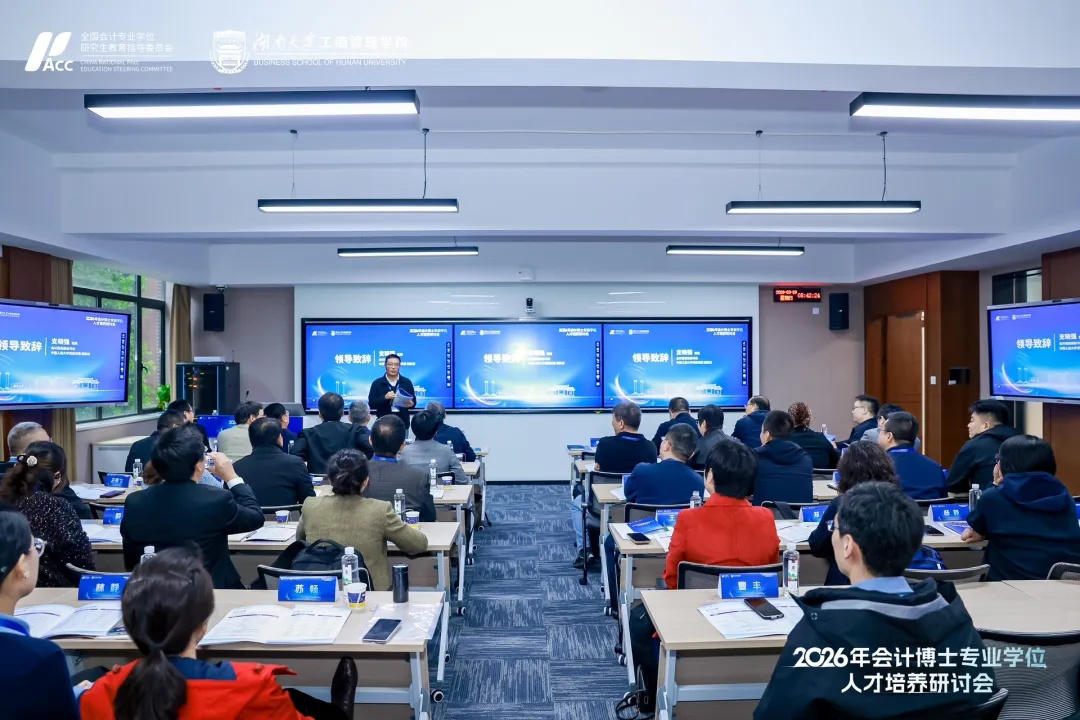
Photos from the symposium venue